
Agency workers face unique challenges in today’s employment landscape. Whether you’re working through a staffing firm, employment agency, or temporary placement service, understanding your legal protections is essential. Many workers mistakenly believe that working through an agency means fewer rights or protections than traditional employees enjoy. The reality is that agency workers rights encompass a broad spectrum of federal and state protections that apply regardless of your employment arrangement. This comprehensive guide explores the legal framework protecting agency workers, common violations, and practical steps to assert your workplace rights in 2026.
Understanding Your Status as an Agency Worker
Agency workers occupy a distinctive position in the employment relationship. You may be employed by the staffing agency while performing work for a client company, creating what labor law experts call a “triangular employment relationship.”
This arrangement doesn’t diminish your protections. Federal law recognizes both the staffing agency and the client company as potential employers, depending on the circumstances. The U.S. Equal Employment Opportunity Commission offers guidance on employment agencies’ obligations under Title VII, clarifying that discrimination protections extend to all workers regardless of their employment structure.
The Dual Employer Framework
Understanding who qualifies as your employer matters because it determines who holds responsibility for protecting your rights. In many situations, both the staffing agency and the client company share employer obligations.
Key employer responsibilities include:
- Ensuring workplace safety and health standards
- Preventing discrimination and harassment
- Providing proper wages and overtime compensation
- Maintaining accurate work records
- Honoring labor law protections
The staffing agency typically handles payroll, benefits administration, and initial hiring decisions. Meanwhile, the client company controls day-to-day work assignments, supervision, and workplace conditions. Both entities bear responsibility for ensuring agency workers rights remain protected throughout your assignment.

Federal Protections for Agency Workers
Agency workers enjoy the same fundamental federal protections as traditional employees. These rights form the foundation of workplace fairness and cannot be waived or diminished because of your agency status.
Anti-Discrimination Laws
Title VII of the Civil Rights Act prohibits employment discrimination based on race, color, religion, sex, or national origin. These protections extend fully to agency workers. The EEOC policy guidance defines what constitutes an employment agency and explains how discrimination charges should be investigated when agency workers face unfair treatment.
Additional federal anti-discrimination laws protect against:
- Age discrimination (workers 40 and older)
- Disability discrimination
- Pregnancy discrimination
- Genetic information discrimination
- Equal pay violations based on sex
Both your staffing agency and client company must comply with these requirements. If either entity discriminates against you during hiring, job assignments, or termination, you have legal recourse through the EEOC.
Workplace Safety Standards
The Occupational Safety and Health Act establishes your right to a safe workplace. This OSHA publication outlines workers’ rights to a safe and healthful workplace, emphasizing that temporary and agency workers receive identical protections as permanent employees.
| Your OSHA Rights | Agency Responsibilities | Client Company Responsibilities |
|---|---|---|
| Hazard-free workplace | Provide safety training | Maintain safe conditions |
| Protective equipment | Supply necessary PPE | Ensure proper equipment use |
| Report unsafe conditions | Investigate complaints | Address hazards promptly |
| Refuse dangerous work | Support worker rights | Provide alternative assignments |
Neither the staffing agency nor the client company can retaliate against you for reporting safety violations or refusing work that poses imminent danger to your health.
Wage and Hour Protections
The Fair Labor Standards Act (FLSA) guarantees minimum wage and overtime pay for covered workers. Agency workers rights under the FLSA include:
- Minimum wage compliance for all hours worked
- Overtime pay at 1.5 times your regular rate for hours exceeding 40 per week
- Accurate timekeeping and payment for all compensable time
- Protection against illegal deductions that reduce pay below minimum wage
Your staffing agency typically handles payroll, making them primarily responsible for wage compliance. However, the client company shares liability if they control your work hours or know about wage violations.
State-Level Protections and Variations
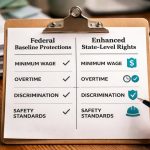
Many states provide additional protections beyond federal minimums. Understanding your state’s specific requirements enhances your ability to recognize and address violations of agency workers rights.
Enhanced State Protections
New Jersey offers robust protections for temporary workers. The New Jersey Department of Labor details protections for temporary workers, including requirements for written contracts, itemized pay statements, and equal treatment regarding workplace conditions.
Common state-level protections include:
- Written employment agreements detailing pay rates and terms
- Requirements for itemized wage statements
- Mandatory rest and meal breaks
- Paid sick leave provisions
- Protection against wage theft
- Enhanced anti-retaliation protections
New York City has implemented comprehensive worker protection laws. New York City’s Department of Consumer and Worker Protection provides information on job applicant rights, pay transparency, and employment agency regulations that strengthen agency workers rights within city limits.
Regional Compliance Considerations
Your location significantly impacts which protections apply. States like California, Washington, and Massachusetts have enacted progressive labor laws providing expanded rights for agency workers.
Research your specific state and local requirements. Many municipalities have implemented:
- Higher minimum wages than federal standards
- Mandatory scheduling notice requirements
- Predictive scheduling protections
- Enhanced workplace safety regulations
- Stricter anti-discrimination provisions
Common Violations of Agency Workers Rights
Despite comprehensive legal protections, violations occur regularly. Recognizing common patterns helps you identify when your rights have been compromised.
Misclassification Issues
Some agencies improperly classify workers as independent contractors rather than employees. This misclassification denies you access to:
- Minimum wage and overtime protections
- Unemployment insurance benefits
- Workers’ compensation coverage
- Anti-discrimination protections
- Family and medical leave rights
True independent contractors control how, when, and where they work. If the agency or client company directs your work activities, sets your schedule, or provides your tools and equipment, you’re likely an employee entitled to full protections.
Discriminatory Practices
Discrimination takes many forms in agency work settings. Watch for these red flags:
- Assignment decisions based on protected characteristics
- Harassment from supervisors or coworkers
- Unequal pay for substantially similar work
- Denial of reasonable disability accommodations
- Pregnancy-related adverse actions
Both the staffing agency and client company can be held liable for discriminatory practices that violate agency workers rights.
Safety Violations
Agency workers often receive inadequate safety training or are assigned hazardous tasks without proper equipment. Common safety violations include:
| Violation Type | Example | Your Rights |
|---|---|---|
| Inadequate training | Assigned to operate machinery without instruction | Receive comprehensive safety training |
| Missing PPE | Required to work with chemicals without protective gear | Obtain necessary protective equipment |
| Unsafe conditions | Exposed to fall hazards without guardrails | Report hazards without retaliation |
| Insufficient breaks | Denied rest periods during physically demanding work | Take required rest and meal breaks |
Asserting Your Rights as an Agency Worker
Knowledge alone isn’t sufficient. You must actively protect your interests when violations occur.
Documentation Strategies
Maintain detailed records of your employment relationship. Essential documentation includes:
- Written employment agreements and assignments
- Pay stubs and wage statements
- Time records and work schedules
- Safety training certificates
- Correspondence with agencies and clients
- Witness information for incidents
Contemporary records provide powerful evidence if you need to file complaints or pursue legal action. Photograph or screenshot relevant information using personal devices.
Internal Complaint Procedures
Start by reporting violations through established channels. Contact your staffing agency’s human resources department or compliance office. Many agencies maintain hotlines or online reporting systems for worker concerns.
When filing internal complaints:
- Submit written complaints rather than verbal reports
- Clearly describe the violation and relevant facts
- Reference specific agency workers rights that were violated
- Request written confirmation of your complaint
- Follow up if you don’t receive timely responses
Document all communications regarding your complaint. Note dates, times, participants, and outcomes of conversations or meetings.
Government Agency Resources
When internal complaints prove ineffective, government agencies enforce agency workers rights through investigations and enforcement actions.
The National Labor Relations Board handles complaints involving collective bargaining, union organizing, and unfair labor practices. Agency workers have the right to discuss wages, form unions, and engage in protected concerted activity.
File complaints with appropriate agencies based on violation type:
- EEOC: Discrimination, harassment, retaliation
- Department of Labor: Wage theft, overtime violations, FMLA violations
- OSHA: Workplace safety hazards
- NLRB: Union-related rights, collective action
- State labor departments: State-specific violations
Most agencies require complaints within specific timeframes. File promptly to preserve your rights.

Special Situations Affecting Agency Workers
Certain circumstances create additional complexity for agency workers navigating their legal protections.
Joint Employment Determinations
Courts and agencies apply various tests to determine whether both the staffing agency and client company qualify as joint employers. This determination affects who bears responsibility for violations.
Factors considered include:
- Who controls work schedules and assignments
- Which entity provides training and supervision
- Who determines pay rates and employment terms
- The permanency of the work relationship
- Whether the client company could hire you directly
Joint employment findings hold both entities accountable for protecting agency workers rights, increasing your options for remedies when violations occur.
Transition to Permanent Employment
Some agency assignments lead to direct hire opportunities with client companies. Understanding your rights during this transition prevents exploitation.
Staffing agencies may charge placement fees when clients hire agency workers. These fees should never be deducted from your wages. Review your agency agreement carefully to understand any contract provisions affecting permanent employment opportunities.
Union Rights and Collective Action
Agency workers can organize unions and engage in collective bargaining. The National Labor Relations Act protects your right to discuss wages and working conditions with coworkers, whether or not a union exists.
Recent enforcement actions highlight that federal contractors violating workers’ rights harm the U.S. government, demonstrating increased scrutiny on employer compliance across all work arrangements.
Industry-Specific Considerations
Different industries present unique challenges for agency workers. Tailoring your understanding to your specific field strengthens your ability to recognize and address violations.
Healthcare and Medical Staffing
Healthcare agency workers face particular concerns regarding:
- Professional liability insurance coverage
- Access to patient information systems
- Continuing education requirements
- Licensing and credential verification
- Exposure to infectious diseases and hazardous materials
Ensure your agency provides appropriate malpractice coverage and safety equipment for healthcare settings. You have the right to refuse assignments for which you lack proper credentials or training.
Manufacturing and Warehouse Work
Industrial settings pose significant safety risks. Agency workers in manufacturing and warehousing should prioritize:
- Comprehensive safety training before equipment operation
- Proper protective equipment for all hazardous tasks
- Clear emergency procedures and evacuation routes
- Regular safety inspections and hazard assessments
- Ergonomic evaluations for repetitive tasks
Report unsafe conditions immediately. Neither your agency nor the client company can retaliate against you for raising safety concerns.
Professional and Office Environments
White-collar agency workers encounter different challenges:
- Intellectual property rights and work product ownership
- Access to professional development opportunities
- Equal consideration for advancement and promotion
- Inclusion in workplace benefits and perks
- Protection of confidential information
Even in professional settings, agency workers rights include equal treatment regarding workplace conditions and freedom from discrimination.
Emerging Trends in Agency Work
The agency work landscape continues evolving. Staying informed about developing trends helps you anticipate and address new challenges.
Technology Platforms and Gig Arrangements
Digital platforms increasingly connect workers with opportunities. These arrangements raise questions about:
- Employment status and worker classification
- Algorithmic management and fairness
- Data privacy and surveillance
- Access to benefits and protections
- Collective bargaining rights
Courts and regulators continue examining how traditional employment laws apply to platform-mediated work. Your fundamental rights remain protected regardless of the technology facilitating your work arrangements.
Legislative Developments
Congress and state legislatures regularly consider bills affecting agency workers rights. Recent legislative efforts focus on:
- Strengthening joint employment standards
- Enhancing wage theft penalties
- Expanding portable benefits systems
- Improving workplace safety enforcement
- Protecting organizing and collective bargaining rights
Monitor legislative developments in your jurisdiction. Workplace laws evolve constantly, often expanding protections for vulnerable workers.
Enforcement Priorities
Federal and state enforcement agencies periodically announce strategic priorities guiding their investigative efforts. Recent enforcement initiatives emphasize:
High-priority violation areas:
- Misclassification of employees as contractors
- Retaliation against workers asserting rights
- Wage theft and overtime violations
- Workplace safety in high-hazard industries
- Discrimination against vulnerable populations
Understanding enforcement priorities helps you assess whether your situation warrants government intervention.
Building Long-Term Career Success
While protecting your immediate rights remains essential, strategic career planning creates sustainable pathways for agency workers.
Skill Development and Training
Invest in building marketable skills that increase your value and bargaining power. Many agencies offer training programs for workers seeking skill enhancement.
Request assignments that develop your capabilities. Document your expanding skill set, certifications, and accomplishments. This portfolio strengthens your position when negotiating assignments or seeking permanent employment.
Professional Networking
Build relationships with colleagues, supervisors, and industry contacts. Professional networks provide:
- Job leads and opportunity awareness
- References and recommendations
- Industry knowledge and best practices
- Support during challenging situations
- Collective strength when addressing workplace issues
Maintain professional social media profiles highlighting your skills and experience. Many opportunities arise through personal connections rather than formal job postings.
Financial Planning
Agency work may involve assignment gaps or variable income. Develop financial resilience through:
- Emergency savings covering 3-6 months expenses
- Understanding unemployment insurance eligibility
- Exploring portable benefit options
- Planning for healthcare coverage transitions
- Building diverse income streams
Financial security reduces pressure to accept unfavorable assignments or tolerate rights violations due to economic necessity.
Understanding and asserting agency workers rights empowers you to build a sustainable, rewarding career while ensuring fair treatment throughout your employment journey. These protections exist to create equitable workplaces where all workers can thrive regardless of their employment arrangement.
If you’re facing workplace challenges or want to learn more about your specific rights, Workplace Fairness offers comprehensive resources, educational materials, and guidance on navigating complex employment situations. Their nonprofit mission centers on empowering workers with the knowledge and tools needed to protect their rights and achieve workplace fairness.